
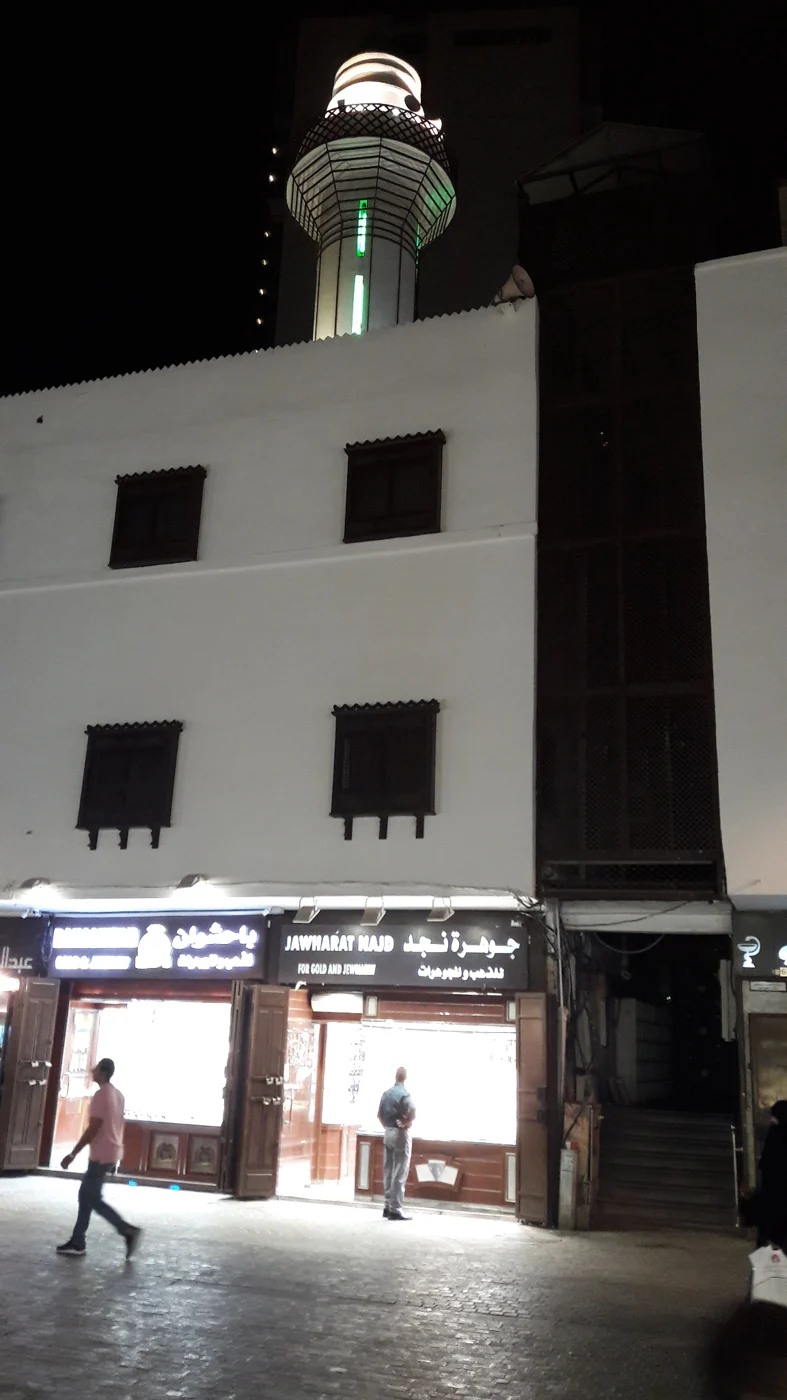
On the way to Qabil Street in the Al-Mazloum quarter, Akkash Mosque stands among the shops of Historic Jeddah. Its location is the starting point for understanding the building. The Historic Jeddah programme records the mosque as early as 1134 AH (1722 CE) and describes a time when it faced a maritime square. Today the nearby Al-Malikah building and Souq Al-Nada help orient visitors in a streetscape shaped by commerce.
From a maritime square to a market street
Look for the mosque on the northern side of Qabil Street, as identified in the Historic Jeddah World Heritage nomination. Find a spot out of the flow of pedestrians and take a moment to look at both sides of the street. Where does the route narrow? How close are the shops to the approach to the mosque? The relationship is easier to grasp from the street than from a close view of the building alone.
The maritime square belongs to the history of the site. The Historic Jeddah programme describes it as part of the setting in the thirteenth century AH and identifies the markets and shops that surround the mosque today. Use the official site listing and map to locate the mosque, and the Historic Jeddah markets guide to plan the rest of your walk.
Three details that explain the building
The earliest documentation
The programme gives 1722 as an early documented date in the mosque’s history. The nomination dossier held by UNESCO associates Akkash Abaza with construction or restoration. These details answer different questions about the site. One tells you how far back the programme traces the record, while the other preserves an account of work associated with the person whose name the mosque bears.
Renovation and reconstruction
The programme records a renovation in 1863 and a reconstruction in reinforced concrete around 1960. The nomination dossier dates that major reconstruction to 1959. Both sources place the work around the turn of the decade. The programme also describes raising the floor above street level. Look for that change in level from the public lane if your sightline allows. It is a tangible connection between the historical record and what you see during your visit.
Shops and the mosque endowment
Some surrounding shops were endowed to support the building and its upkeep, according to the Historic Jeddah programme. The proximity of commerce and worship therefore tells part of the story of how the mosque was maintained. Observe that relationship from the public street. Establishing which individual property belongs to the endowment would require its own documentary evidence.
How to include Akkash Mosque in your Al-Balad walk
Use the location on the official listing and plan a short exterior stop. If you photograph the setting, leave room for shoppers and worshippers to pass and choose a wider angle that places the building in its market context. Move group explanations away from the entrance around prayer time. Check locally about permission and timing before planning an interior visit or taking photographs inside.
If your group wants to limit steps, make the street view your main stop and decide on a suitable viewing position once you see the pedestrian traffic. Continue toward the markets or include the mosque in a guided Historic Jeddah walk to connect its story with the nearby quarters and shops.
Photograph of Akkash Mosque, February 2019, by Tahir mq via Wikimedia Commons, CC BY-SA 4.0. Resized and converted to WebP.
Planning a visit? Meet Adel Alsulami, your licensed Jeddah tour guide and discuss a private itinerary around your interests.


