Jeddah Rawasheen: A Visitor’s Guide to Architecture and Photography
Your first photograph in Al-Balad may be a building with patterned wooden structures projecting over the street. Before lifting your camera, pause for a closer look. Where does the timber begin and end? How are the openings arranged across the upper floors? What is the relationship between the frontage, its doorway and the lane below? Simple questions turn an attractive background into something you can explore.
This guide offers a way to observe architecture while walking. It is not a conservation survey or a catalogue of every historic house. Use it to distinguish visible details from claims that require documentation and to plan a focused visit. For arrival, orientation and a broader route, also read the Historic Jeddah visitor guide.
What are rawasheen?
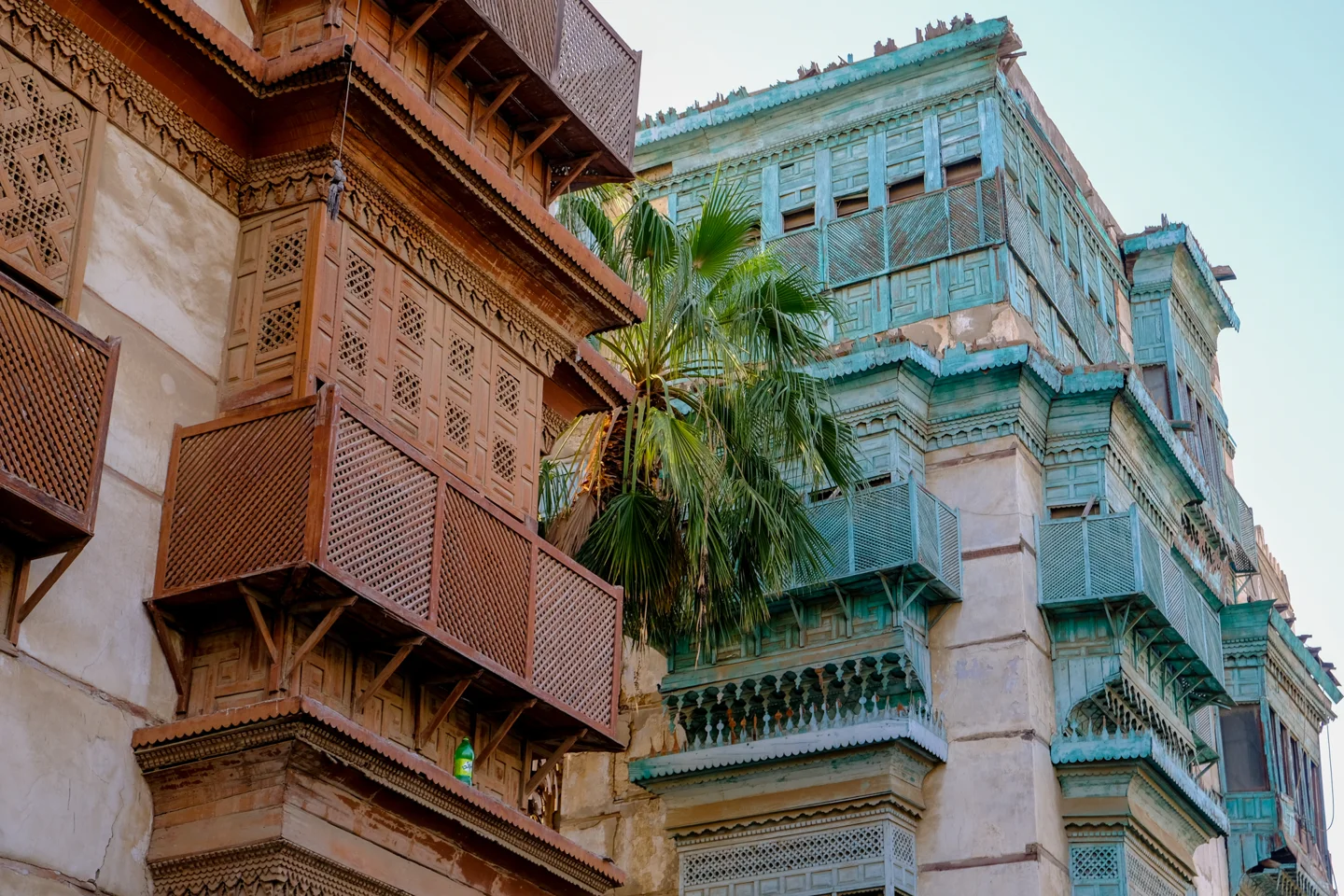
Rawasheen is the plural of roshan, a term you may encounter in descriptions of traditional Hijazi buildings. Saudipedia’s account of rawasheen describes projecting wooden features covering exterior openings and explains their relationship to light, airflow and privacy. They belong to the architectural vocabulary of Jeddah and other Hijazi cities. The woodwork therefore has a practical context as well as a decorative one.
You do not need to memorise technical classifications before visiting. Compare an opening set into the wall with a wooden element that extends beyond it. Notice its depth, height and repeated components. Avoid assigning a precise type from a distant photograph, or treating matching paint colours as proof that two features were made at the same time. Begin by describing what is visible.
Read a frontage from the whole building to the smallest detail
First, look at the relationship with the street
Choose a public position where you will not obstruct anyone. Take in as much of the building as the space allows: its entrance, the area in front of it, and the balance between the upper floors and street level. Notice how the view changes as you approach. A narrow angle may conceal part of a frontage, while a side view may reveal the depth of the timber more clearly.
Next, follow the arrangement of openings
Trace the vertical lines and then the horizontal ones. Some details read as a continuous composition; others appear as separate repeated elements. Compare two parts of the same frontage before moving to another building. Three brief notes on your phone—size, arrangement and relationship to the doorway—can help you remember why a particular photograph interested you.
Finally, choose one small detail
Look for repeated shapes, openings and shadows within the timber. Observe from a suitable distance without touching or attempting to open anything. If a detail cannot be seen from an accessible public position, leave it or use modest optical zoom. A good visit does not require access to every corner. One careful comparison can be more rewarding than a long sequence of hurried pictures.
Ask about light, air and privacy
Rather than only asking whether a house is old, try questions tied to the scene: which openings appear to admit light? Where do shadows fall? What can you see from the street, and what remains screened? These are prompts for observation and discussion, not measurements of building performance. An exterior photograph cannot establish the temperature of a room or the effectiveness of its ventilation.
When a guide explains a feature, ask how the explanation connects to what you are looking at. Is it a general point about rawasheen, or a documented fact about this particular house? A broad architectural principle does not prove the age of each window or the former use of every room. Keeping the distinction clear makes the conversation more informative.
Nassif House: an example, not a template for every building
Nassif House can form part of an architecture-focused walk, with viewing the exterior kept separate from permission to enter. Use the photograph below as a visual exercise: compare the dark timber areas with the pale walls and follow the changes in the size and arrangement of the openings. These observations describe the image. They do not establish that the site or its visitor arrangements are unchanged since it was taken.
Compare another frontage during your walk. The purpose is not to declare one building the most beautiful, but to understand why your response differs. Viewpoint, lighting and the apparent scale of the visible elements may all affect the impression. This gives photographers a clear subject and offers visitors without architectural training an accessible way into the discussion.
Photographing rawasheen with a phone
Start with three pictures that do different jobs: a wider view placing the building in its street, a medium view of the frontage, and one timber detail. Let each frame add information. Try a vertical composition when height is your subject and a horizontal one when you want to show the relationship between several frontages and the lane.
Keep the phone reasonably upright if you want to reduce the appearance of leaning vertical lines. Step back only when the space behind you is safe. Avoid excessive digital zoom, and check exposure so that pale walls retain detail and dark wood does not become a featureless patch. There is no single ideal hour for every frontage: its orientation and the available shade matter.
For a broader plan covering subjects, timing and equipment, read the Jeddah photography walk guide. On this walk, choose a narrow theme, such as contrasting openings or the relationship between timber and shadow. That also helps keep the outing enjoyable for companions who are not spending as much time with a camera.
Restoration and age: know what needs evidence
Paint colour or weathering alone cannot tell you the age of a component or establish whether it is original. If that information matters, look for an identification panel or a reliable source specific to the building. A caption such as “wooden detail in Historic Jeddah” is more useful than an exact date you cannot support. Clear description is a good alternative to an appealing but unverified story.
Respect barriers and conservation work. Do not enter a workshop or a closed building for a better angle. If a temporary closure changes the route, choose another public viewpoint. Ask before photographing people or shop interiors, and avoid directing your camera into private domestic spaces. Thoughtful photography is part of visiting a living district.
Build a walk around your interests
Choose a small number of frontages and leave room for comparison and questions. Agree on the start and finish points, a comfortable walking distance, breaks and whether photography is the main purpose or a secondary activity. With children, try looking for three different opening shapes without touching the buildings. If architecture forms one part of a longer day, use the one-day Jeddah itinerary to avoid crowding the schedule.
Before booking, discuss what an Al-Balad walking tour includes. An outdoor architecture walk can be rewarding on its own; an interior visit should be confirmed for the specific property and date, rather than assumed from the word “heritage.”
Frequently asked questions
Do I need architectural knowledge?
No. Comparing size, colour, arrangement and the relationship between two frontages is a useful starting point. Technical terms should clarify what you see, not become a test.
Can I enter every house with rawasheen?
Do not assume so. Confirm access to the named building on your chosen date and check any booking or ticket requirements separately. An exterior view is not permission to enter.
Is all the visible woodwork original?
Appearance alone cannot answer that. Claims about originality or restoration require information about the specific building and component.
Is daylight better than evening?
Daylight can help reveal detail; evening lighting changes shadows and colour. Choose according to your photographic purpose and assess the actual light rather than expecting every street to look the same.
Explore Al-Balad’s architecture with Adel Alsulami
For a visit focused on buildings and photography, request a private tour with Adel Alsulami, a licensed Saudi tour guide, licence number 40000511, and professional photographer. Share your interests, available time and walking requirements, then discuss the route and inclusions before booking. A rewarding walk leaves you with more than photographs: it gives you new details to notice on the next street.
Source reviewed: 12 October 2026. The definition and general functions of rawasheen are based on Saudipedia; observation and photography exercises are editorial suggestions. No live opening hours or admission prices are stated. Featured photograph: Francisco Anzola via Wikimedia Commons, CC BY 2.0; resized and converted to WebP.
Book the Historic Jeddah (Al-Balad) tour with Adel Alsulami — 2–4 hours, SAR 500
Planning a visit? Meet Adel Alsulami, your licensed Jeddah tour guide and discuss a private itinerary around your interests.