Historic Jeddah Gates: Names, Stories and Visiting Advice
Jeddah’s historic gates help you imagine a city with more clearly defined boundaries, where entering and leaving was connected with the routes of travellers and goods. Before photographing them, make one useful distinction: a gate’s historical name, its location and the structure you see today are separate subjects. A familiar name can survive changes to walls, streets and the landmark itself.
This guide introduces the names and helps you include them in an Al-Balad walk. It does not promise that every former gate survives unchanged. For your first outing, combine it with the Historic Jeddah visitor guide. The history of Jeddah as a pilgrimage and trading gateway explains the wider setting.
The wall and its gates
Saudipedia lists seven gates built in stages: Bab Makkah, Bab Sharif, Bab al-Subbah, Bab al-Magharibah, Bab Sarif, Bab al-Nafi’ah and Bab al-Madinah. Bab Jadid was added on the northern side in the early Saudi period. It records the wall’s removal in 1947 as Jeddah expanded. References to seven or eight gates therefore need a period attached to them.
A Sabq report dated 11 September 2026 describes the gates as passages for pilgrims, merchants and caravans, and connects Bab Jadid’s addition with admitting vehicles. These points explain the function of entrances and changing transport needs. They do not establish that every visible stone or arch belongs to the same historical phase.
Names you may hear during a tour
Bab Makkah: an entrance and a direction
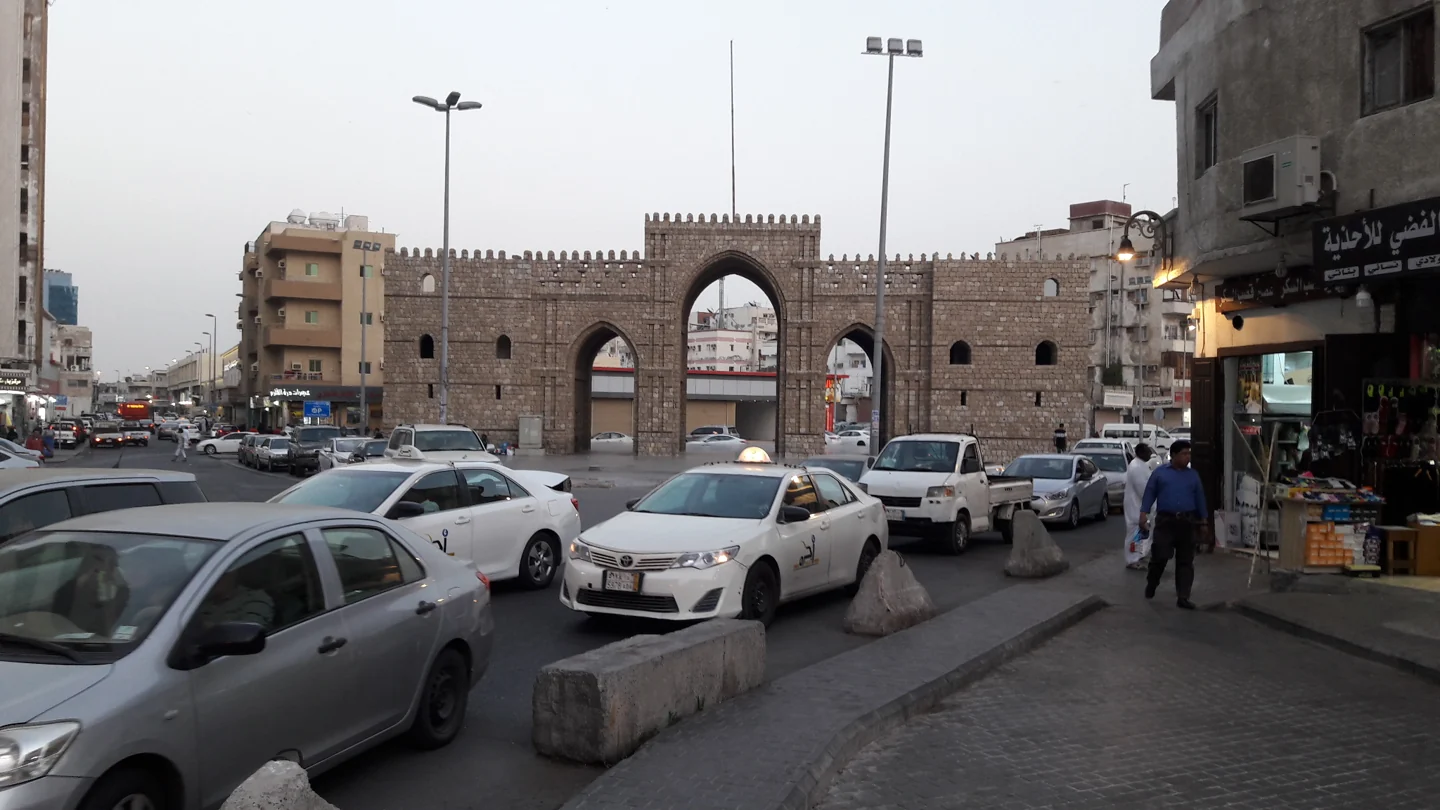
Saudipedia identifies Bab Makkah as opening towards Makkah. Its name connects Jeddah with the destination many arrivals continued towards. When visiting the surroundings, relate the name to the map and the city’s story, then ask separately about the standing structure, its date and later changes. A historical name alone cannot establish the age of the frontage.
The featured photograph documents the landmark in 2019. Its arches and the street activity are visible, but the image does not confirm today’s traffic or parking arrangements. Use it to recognise the photographed scene, then check your actual meeting point when organising the visit.
Bab al-Madinah: a name associated with a route
The newspaper report connects Bab al-Madinah with the road to Madinah. Keep that relationship in mind without assuming that a modern map route recreates an earlier journey. Roads change, and a historical place name does not automatically define a suitable walking or driving route now.
Bab Jadid: changing movement through the city
This name provides a useful introduction to a city that was never static. Adding an entrance in a later period reflects changing needs. Distinguish its addition to the wall’s system from the condition of the landmark today. Do not transfer another gate’s date to it, or treat “new” as a description of the present structure’s age.
The other gates: identifying what a name refers to
The list also includes Sharif, al-Subbah, al-Magharibah, Sarif and al-Nafi’ah. A name in a historical record is not enough to direct a visitor to a verified stop. If one particularly interests you, ask for a map or reference that explains its location and phases. Clarify whether the proposed visit concerns a standing structure, a former site or an area carrying the name.
Separate the historical entrance from later construction
Ask three questions independently: where was the gate, what is known about its function, and what is the history of the element standing now? The strength of the evidence may differ for each answer. Where the function is documented but the present structure’s date is uncertain, stop at what is established. The story remains useful without filling a gap with a confident assumption.
Also distinguish “the gate survives” from “the name or location survives.” Historical photographs can reveal differences between earlier and present views. However, noticing a difference does not identify the date or cause of a rebuilding, restoration or removal. Explaining that change requires its own supporting source.
Include gates in a balanced Al-Balad walk
You could use one gate as an introduction, then continue to residential facades, a market and a cultural landmark. Seeing every name on the list is unnecessary for understanding the wall’s role. Choose one theme, such as pilgrims’ movement or the relationship between entrances and markets, and leave other details for a longer visit.
After discussing entrances, the rawasheen guide helps you look more closely at houses. A Nassif House stop can suit a group interested in architecture and history. Including a landmark in an itinerary does not guarantee entry; discuss the nature of each stop and its inclusions before booking.
Getting there, choosing a time and taking photographs
If starting at Bab Makkah, open a Google Maps search for the landmark, then compare the result with your organiser’s meeting point. The link is a search, rather than a confirmed entrance or guaranteed parking location. Share the agreed point and a photograph with your driver, and arrange where the walk will finish.
Daylight can help you examine the overall shape and details, while evening offers a different photographic objective. Observe the actual light, shade and movement rather than relying on one supposedly ideal hour for everyone. Do not step into vehicle traffic for a frontal view. Take a wide composition from a safe position and a closer detail only where you can reach it without obstruction or entering a restricted area.
For families and older visitors, discuss the distance from the drop-off, rest opportunities and walking surfaces. This guide does not assume an obstacle-free route. It does not publish one ticket or operating schedule for all the gates. Any indoor experience or event you add needs separate confirmation from the relevant operator.
Frequently asked questions
Were there seven gates or eight?
Saudipedia describes seven followed by the addition of Bab Jadid. Specify the historical phase when giving a total.
Can I visit every old gate as a standing landmark?
This guide makes no such guarantee. Verify each name, location and what survives before allocating a stop.
Does a photograph establish when a gate was built?
No. It records a scene at a particular time. Construction dates and phases need other evidence.
Can gates fit into a short tour?
Choose one or more stops according to the available route and your group’s time, rather than trying to trace every historical name in one outing.
Explore Al-Balad from entrances to houses
To connect the gates with pilgrimage, trade and architecture, request a private tour with Adel Alsulami, a licensed Saudi tour guide, licence number 40000511. Share your interests and discuss the route and stops so the names contribute to a clear understanding of the city.
Sources reviewed on 13 October 2026. Featured photograph: Tahir mq / Wikimedia Commons, taken 27 April 2019, CC BY-SA 4.0. Resized and converted to WebP; the adapted image is distributed under the same licence.
Book the Historic Jeddah (Al-Balad) tour with Adel Alsulami — 2–4 hours, SAR 500
Planning a visit? Meet Adel Alsulami, your licensed Jeddah tour guide and discuss a private itinerary around your interests.