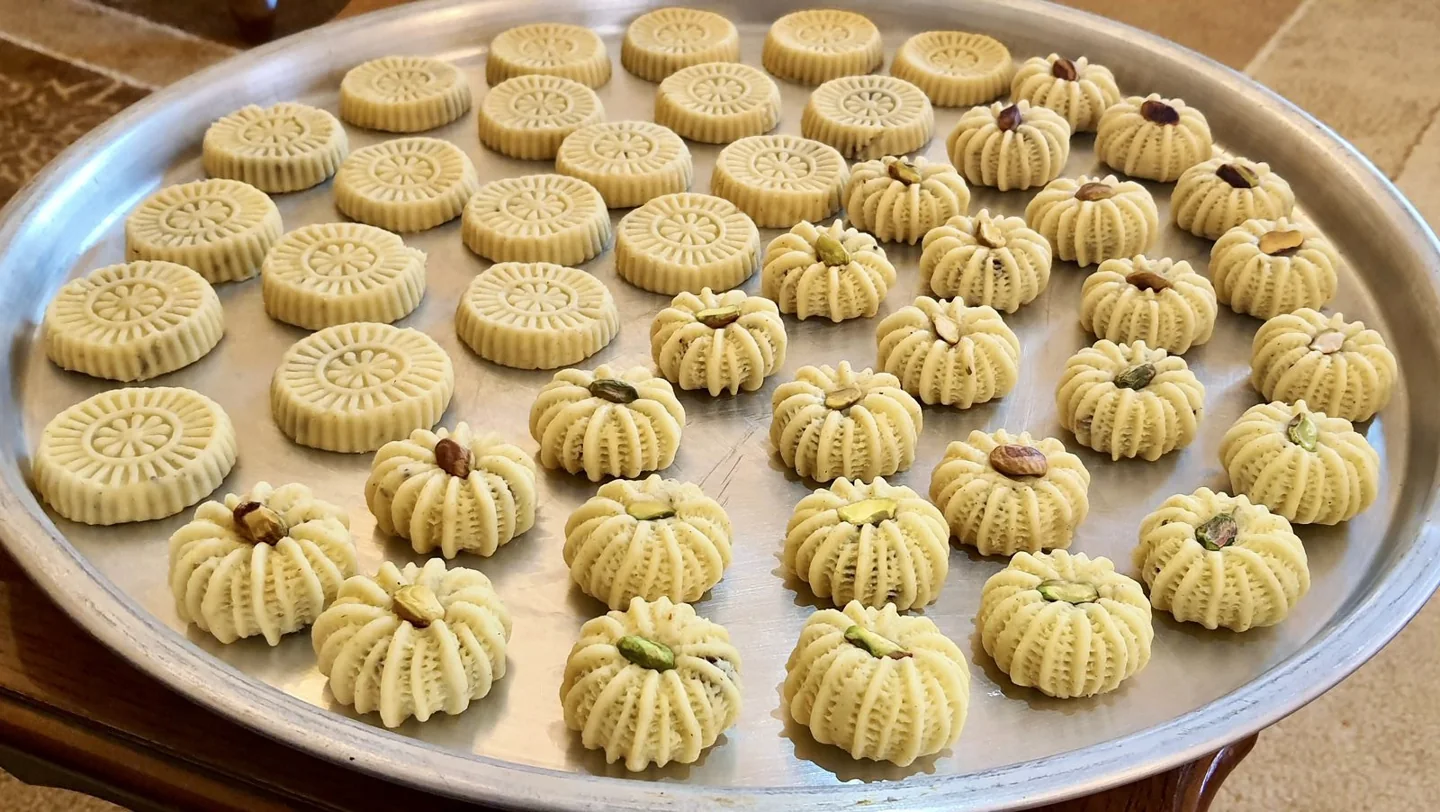
Hijazi Sweets in Jeddah: Dibyazah, Labaniyah and Maamoul
Exploring Hijazi sweets in Jeddah starts with recognising names and deciding what you want: something to eat immediately, a few pieces with coffee, or a box to give as a present. Recipes, piece sizes and packaging vary between businesses. Ask about the product in front of you rather than relying on an old photograph or a general menu name.
This guide focuses on dibyazah, labaniyah, maamoul and ghraybeh, with other names you may encounter in an assortment. A sweet associated with Hijaz is not necessarily exclusive to it, and being popular in Jeddah does not establish that it originated here. For wider context, read the Hijazi food culture guide.
Dibyazah: a sweet connected to the Eid table
Visit Madinah describes dibyazah as part of Hijazi heritage and Eid celebrations, made with ingredients including dried apricot, dried fruits, dates and nuts, with household variations. Saudipedia also documents it at Eid al-Fitr breakfast in old Jeddah. Its connection to the occasion is part of its meaning, rather than a promise that every shop has it every day.
Ask whether it is available now or requires an advance order, and whether it is sold by weight or in a defined container. Establish the size, ingredients and serving approach recommended by the maker. If taking it away, request storage instructions for that actual product. Do not assume that every sweet containing dried fruit can be carried under the same conditions.
Labaniyah: ask which version is being offered
Maamoul Tahlia’s plain labaniyah product page lists milk, cardamom and sugar among its ingredients, while the shop also offers a rose-flavoured version. This illustrates variation within a single name; one retailer’s recipe does not define every labaniyah made in Jeddah. Ask about flavour, main ingredients and piece size before choosing a large assortment.
If comparing versions interests you, choose a small amount of plain and another flavour if available. Notice texture, aroma and whether you prefer it on its own or beside a drink. Do not describe a product as free from an ingredient just because you cannot see it on the surface. Read the label or ask the people who prepared it.
Maamoul and ghraybeh: compare fillings and sizes
Maamoul is a filled pastry with different doughs and fillings, sometimes shaped in a decorative mould. Nestlé’s published recipe, for example, uses semolina dough and different fillings; it is one recipe rather than a requirement for every piece. Ask whether a particular filling is dates, nuts or something else, and which dough is used. A pattern alone is not an ingredient label.
Ghraybeh appears in Saudi Press Agency reports about Eid sweet assortments. Maamoul Tahlia also lists almond and peanut versions. The name alone therefore does not answer what a particular product contains. When buying for a group, ask for varieties to be separated and labelled so each person knows what they are selecting.
Laddu and the wider assortment: ask for the name
Saudi Press Agency reports document names including laddu, labaniyah, harisah, coconut sweets, Turkish delight, maamoul and ghraybeh within seasonal selections. Seeing many names does not require buying every one of them. Pick a few that interest you and ask the seller to explain the difference between any pieces that look similar.
For tasting, ask whether one piece or the smallest available quantity can be purchased. Establish whether a sample is complimentary or charged before eating it. Photographing the name card can help you remember a favourite, with permission where required by the shop. It makes returning to the same variety easier than asking later for “the yellow sweet” or “the white piece.”
A verifiable example: Maamoul Tahlia in Al-Safa
Maamoul Tahlia’s own website displays labaniyah, ghraybeh and maamoul, and HungerStation has a listing titled Maamoul Al Tahlia in Al-Safa, Jeddah. Together these provide a starting point for checking products and the location. This is a reference to a retailer and menu, rather than a personal review or a claim that it is the best. A catalogue does not establish that every item is in stock at the branch at this moment.
Before travelling, confirm the collection address, service hours and whether the business offers seating or focuses on takeaway and delivery. A delivery-platform menu does not establish that you can sit down there or visit without ordering. If staying elsewhere in the city, compare travel time with a nearby purchase instead of adding a long journey to an already busy day.
A gift box: weight, packaging and storage
Decide who the gift is for and when it will be presented before choosing the box. Ask whether packaging is included in the price, what the net weight of sweets is, and whether you can choose the assortment. Piece count is not enough to compare products when sizes differ, and a larger box does not necessarily contain more food.
Request production and expiry information and storage directions from the label or seller. Explain the length of your journey and the expected transport conditions so suitable packaging can be discussed; that discussion does not override the product’s instructions. If travelling internationally, check your destination’s food-entry requirements before buying and retain the original packaging and label where possible.
Separate something you will eat during a break from a gift intended to stay sealed. A small mixed purchase can suit tasting, while a present needs packaging that can be carried and clear product information. Once opened, follow the relevant instructions rather than assuming the unopened storage conditions remain applicable.
Fit a sweet stop into the day
If you already have a main meal planned, a piece or two with a drink may be enough. Agree whether the stop is about tasting or buying gifts: browsing, comparing and packaging need a different amount of time from sitting down for a short break. For the drink, see the Saudi coffee visitor guide.
Tell Adel which sweets interest you, particularly if one is seasonal. Discuss a stop that fits the route, with availability and payment for purchases confirmed. Sweets, delivery and factory visits are not automatically included in a walking tour. If you want to shop after the guided part ends, establish how that fits your onward transport and other plans.
Frequently asked questions
Is dibyazah available throughout the year?
Its association with Eid does not establish daily availability. Ask the retailer about stock or advance ordering.
Does the cover show Maamoul Tahlia’s products?
No. It is an independent illustrative maamoul photograph taken in Amman, rather than documentation of this retailer or branch.
How can I identify an assortment’s ingredients?
Ask for product information, labels and the names of individual pieces. Name or colour alone is insufficient.
Sources for names and the retailer
- Visit Madinah: dibyazah.
- Saudi Press Agency: Eid sweets and presentation, 2024.
- Maamoul Tahlia: plain labaniyah and almond ghraybeh.
- Maamoul Al Tahlia listing — Al-Safa, Jeddah.
- Nestlé: an example maamoul recipe.
Contact Adel to discuss a stop that suits your tour.
Maamoul cover photograph: روتانا (Rotana) / Wikimedia Commons, CC BY 4.0; taken in Amman, resized and compressed to WebP. Illustrative dish photograph.
Book the Historic Jeddah (Al-Balad) tour with Adel Alsulami — 2–4 hours, SAR 500 · Contact Adel to book or ask a question
Planning a visit? Meet Adel Alsulami, your licensed Jeddah tour guide and discuss a private itinerary around your interests.