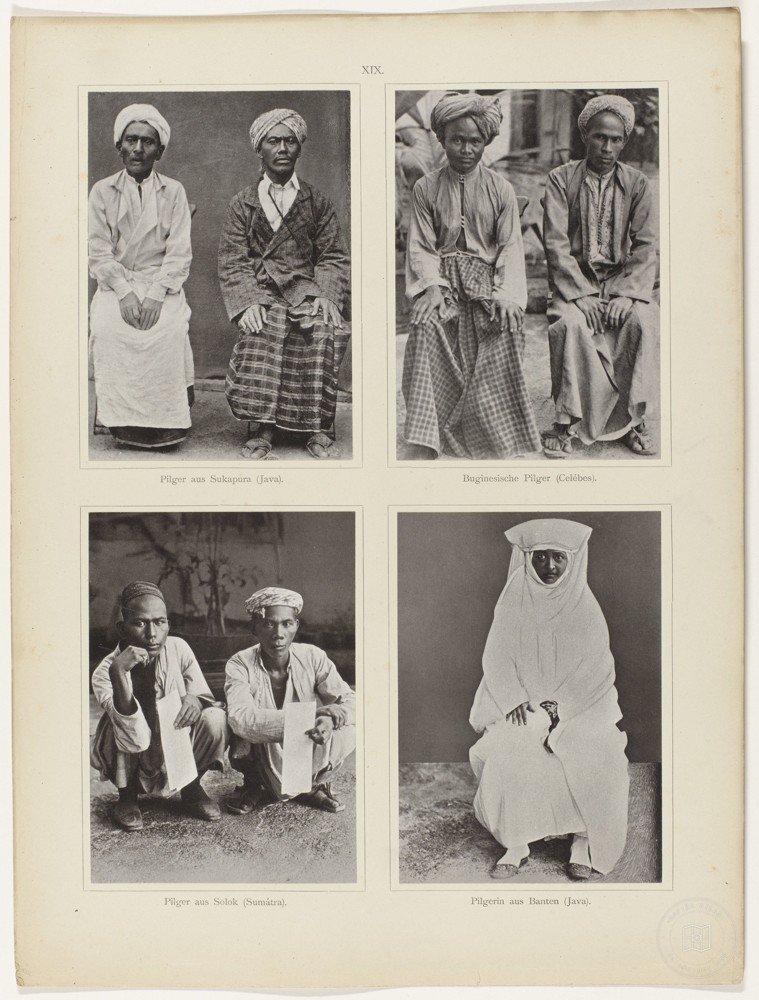
An archival photographic plate brings together pilgrims photographed in Jeddah and identifies their places of origin in Java, Sulawesi and Sumatra. It gives a human scale to the history of Jeddah as a gateway for Hajj. A later chapter in that history is associated with Zeynal House, where one of the Dutch consular offices helped handle the arrival of pilgrims from Indonesia.
What the portraits record
The archive attributes the photographs to Christiaan Snouck Hurgronje and gives a catalogue range of 1884–1888. Printed captions name places including Sukapura and Banten in Java and Solok in Sumatra, and identify Bugis pilgrims from Sulawesi. The place names give a sense of the distances brought together by a stop in Jeddah. The archive identifies the city as Jeddah and gives no precise street address or verified day for the sitting.
How Zeynal House fits into the pilgrimage story
According to the Saudi Press Agency, Zeynal House accommodated one of the Dutch consular offices in Jeddah until 1950. Its duties included following and facilitating the arrival of pilgrims from Indonesia during the period of Dutch rule. Ithraeyat reports that Indonesian pilgrims were required to register with the consulate on arrival until 1949. The dates describe related but distinct activities, the registration of pilgrims and the use of the building as an office.
The Dutch House exhibition
In 2021 the Historic Jeddah district hosted the exhibition Dutch House: A Shared History at Zeynal House. The Saudi Press Agency reported that the exhibition presented material on the building and archival images of life in the Hejaz. The exhibition offers a later point of reference for understanding the building’s story. For a present-day visit, check the Historic Jeddah programme’s public event listings before planning around interior access.
Bring the story into an Al-Balad walk
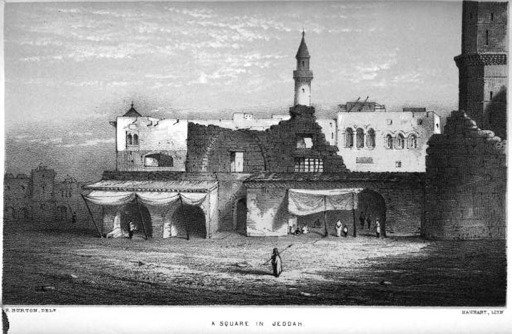
Begin by reading the captions on the photographic plate, then open the historic Jeddah Harbour chart to think about arriving by sea. On the ground, consider how the places where people disembarked and the buildings where they handled formalities served different parts of a journey. Richard Burton’s account of a Jeddah square provides a separate nineteenth-century view of pilgrims moving through public space.
Sources and featured image
Saudi Press Agency and Ithraeyat. Photographs by Christiaan Snouck Hurgronje via the Hafıza Atlası catalogue, identified there as public domain. The plate is shown complete, resized and compressed for the web.
Planning a visit? Meet Adel Alsulami, your licensed Jeddah tour guide and discuss a private itinerary around your interests.