King Saud Mosque in Jeddah: Abdel-Wahed El-Wakil’s Masterpiece and How to Visit
Among the modern towers and busy streets of Al-Sharafeyyah rises a vast brick dome that looks as if it came from another age. This is King Saud Mosque, the largest mosque in Jeddah by site area and one of the most important contemporary Islamic buildings in Saudi Arabia. Many visitors drive past it without knowing its story, yet it deserves a stop just as much as Al-Balad’s rawasheen and ancient mosques. In this article I share the mosque’s story, what makes its architecture special, and how to visit respectfully and enjoy its details.
At a Glance
- Location: Al-Sharafeyyah district, central Jeddah.
- Completed: around 1987.
- Architect: Abdel-Wahed El-Wakil.
- Main material: brick.
- Main dome: roughly 20 metres in span and about 42 metres high.
- Minaret: about 60 metres tall.
- Site area: around 9,700 square metres, making it Jeddah’s largest mosque by area.
The Mosque’s Story
King Saud Mosque stands on the site of an earlier mosque built in reinforced concrete around the mid-twentieth century, which didn’t age well. During Jeddah’s building boom of the 1970s and 1980s, the decision was made to build a new mosque worthy of the city and expressive of its Islamic identity.
The design went to Egyptian architect Abdel-Wahed El-Wakil, who had designed several mosques in Jeddah in that period and whose name became linked with reviving traditional Islamic architecture in a contemporary language. The mosque was shortlisted for the Aga Khan Award for Architecture in 1989 — one of the most prestigious architecture prizes in the Islamic world — which alone tells you its significance.
Who Was Abdel-Wahed El-Wakil?
El-Wakil is an Egyptian architect shaped by the ideas of the famous architect Hassan Fathy, who championed a return to local materials and traditional techniques suited to climate and people. El-Wakil carried these ideas forward, designing buildings based on brick, domes, vaults and courtyards rather than concrete and glass.
In Jeddah, El-Wakil left a clear mark, designing several mosques in the 1980s, including mosques on the Corniche and in various districts. But King Saud Mosque remains the largest and most ambitious. Standing in front of it, you’ll notice the building doesn’t try to look modern or shiny — it tries to be authentic, as if it were a continuation of centuries of Islamic architecture.
What Makes the Architecture Special
Brick instead of concrete
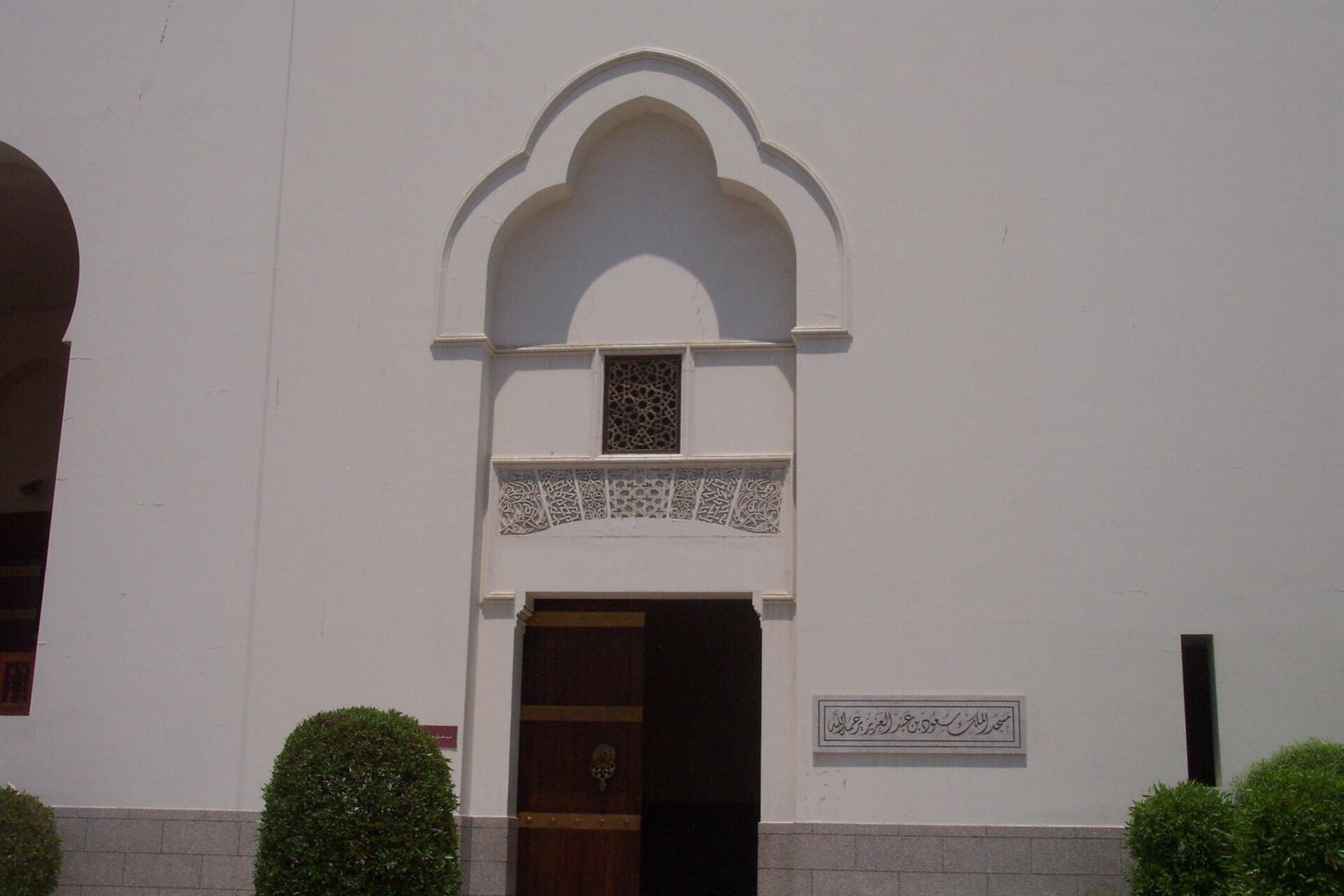
The first thing you notice is the material. The mosque is built mainly of brick — a rare choice for a building of this size at that time. Brick gives it a warm texture and an earthy colour that shifts with the daylight, reflecting the architect’s philosophy of simple materials and traditional techniques like self-supporting domes and arches.
The great dome
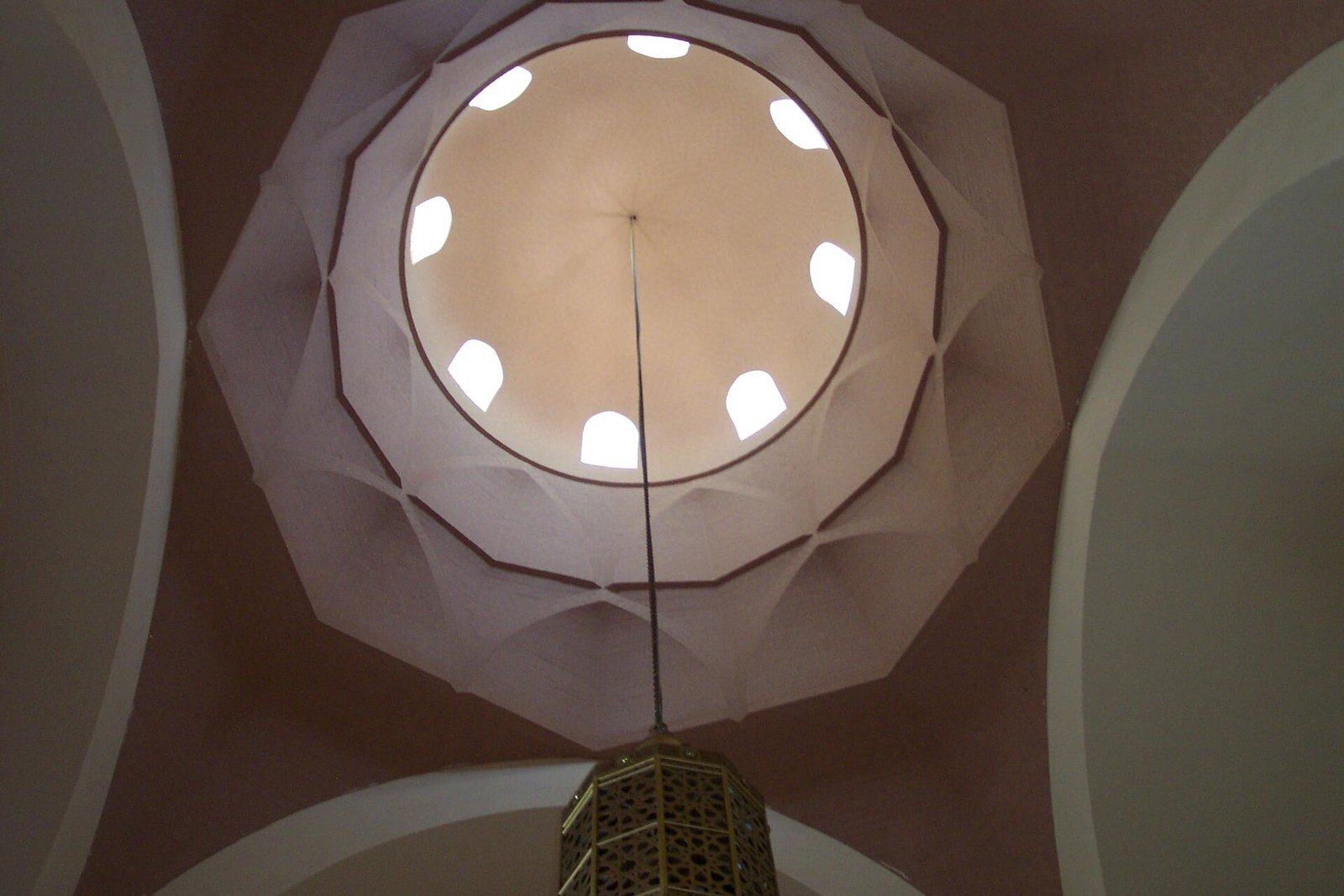
The main dome is the star. With a span of about twenty metres and considerable height, it dominates the view from afar and gives the prayer hall beneath a sense of spaciousness and calm. Smaller domes around it distribute loads and create a beautiful visual rhythm when you look at the building from outside.
The minaret
Rising about sixty metres, the minaret makes the mosque a landmark visible from far across central Jeddah. Its design draws on historic Islamic minarets, with tiers and details that change as it rises.
Iwans and courtyard
The plan draws on the four-iwan layout around a central courtyard, a scheme known from historic Islamic architecture in Iran and Central Asia. An iwan is a vaulted hall open on one side; four of them around a court create a balanced space combining shade, light and air.
Light and shadow
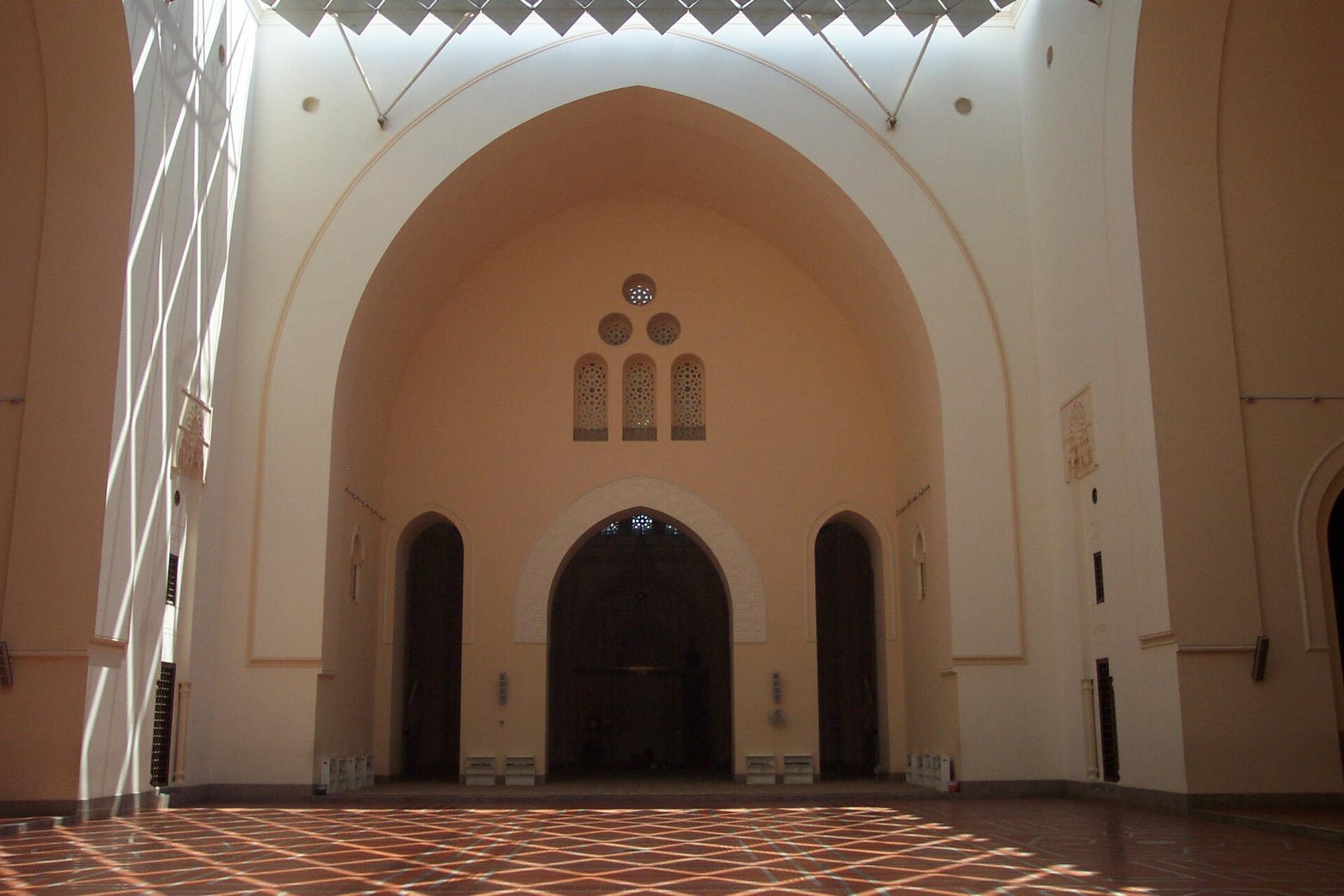
Like all good architecture in a hot climate, the mosque handles light intelligently. Openings are carefully placed, shadows are deep, and light enters gently, giving the interior a serenity far from the noise of the surrounding streets.
Architecture That Respects the Climate
One important lesson of King Saud Mosque is that it doesn’t just revive traditional form; it revives traditional logic for dealing with heat. Thick brick walls slow heat entering, high domes let hot air rise away from worshippers, and the open courtyard helps air move. The same ideas appear, differently, in Al-Balad’s houses with their coral stone and wooden rawasheen. That’s why I see the mosque as a link between old and new Jeddah, and proof that old solutions still work in a hot, humid city. For a deeper look at the historic houses, see my Al-Balad architecture guide.
El-Wakil’s Other Mosques in Jeddah
If you like King Saud Mosque, you’ll be glad to know El-Wakil left Jeddah a group of smaller mosques designed in the mid-1980s, including the Island Mosque, the Corniche Mosque, Al-Ruwais Mosque and Al-Harithy Mosque. They’re much smaller but share the same architectural language: white or earthy domes, arches, calm proportions and an intimate relationship with their setting.
Some sit on or near the sea, forming simple, beautiful scenes with water and sky. For architecture lovers, a tour of “El-Wakil’s mosques” in Jeddah can be a rewarding trip in itself, showing how one architect tried to give a fast-growing modern city an architectural identity connected to its history. Just check access and locations first, as some sites have been affected by waterfront development.
Al-Sharafeyyah: The Mosque’s Setting
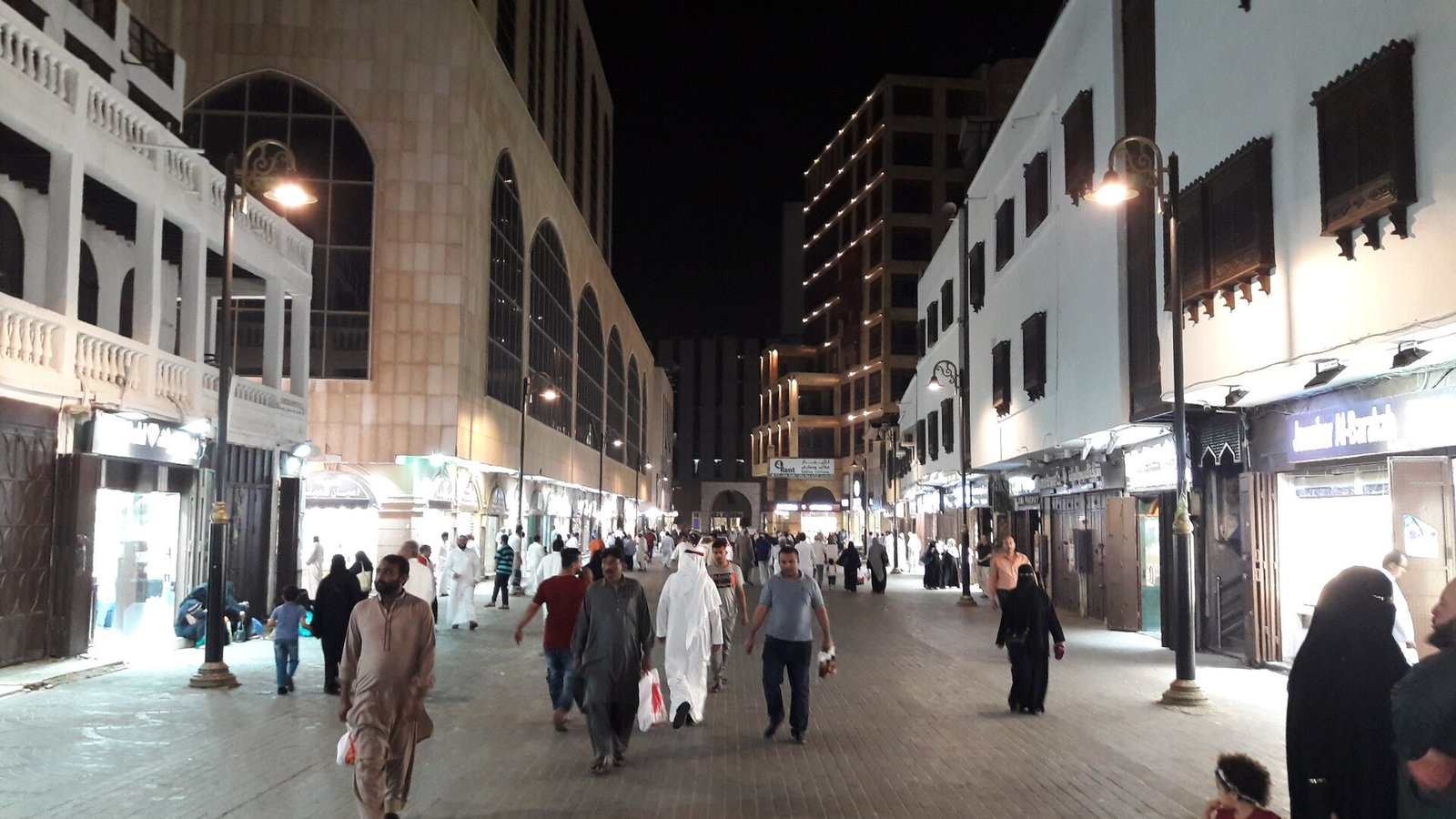
The mosque sits in Al-Sharafeyyah, one of Jeddah’s central districts that grew as the city expanded beyond its old walls in the mid-twentieth century. Today it’s a mix of shops, restaurants, offices and homes, with streets busy most of the day. A mosque this vast and calm in the middle of a bustling district creates a striking contrast: you step from street noise into the courtyard and feel transported within a few paces.
King Saud Mosque and Al-Balad’s Historic Mosques
An idea I love sharing with architecture-minded guests: compare King Saud Mosque with Jeddah’s historic mosques such as Al-Shafi’i and Al-Mi’mar. Al-Balad’s mosques were built of coral stone at a modest scale suited to narrow quarters, while King Saud Mosque expresses a big modern city that refuses to cut itself off from its roots. The comparison tells the whole story of Jeddah: a city that expands and modernises but is always searching for its identity. For more on the old mosques, read my guide to Jeddah’s historic mosques.
Visiting Etiquette
King Saud Mosque is an active place of worship, not a museum. So:
- Dress: fully modest, covering arms and legs, with a headscarf for women.
- Shoes: removed before entering the prayer hall.
- Prayer times: avoid sightseeing during prayers, especially Friday prayer.
- Quiet: speak softly and silence your phone.
- Photography: photograph the exterior freely and avoid photographing worshippers. To shoot inside, ask the staff and choose a time without prayers.
- Non-Muslims: can enjoy and photograph the architecture from outside; for entry, enquire in advance and follow the staff’s guidance.
Best Time to Visit and Photograph
- Early morning: soft light on the brick and lighter traffic around the mosque.
- Before sunset: golden light brings out the brick colour and dome details beautifully.
- After sunset: the lit minaret and dome make a lovely night scene.
- Avoid: prayer times, especially Friday, when the mosque and its surroundings fill with worshippers.
Photo tip: the dome and minaret need distance. Find an angle from across the street or further away to capture the whole building, and use a mid-range lens to isolate the smaller domes and arches.
What to Notice When You Stand in Front of It
I always suggest a simple exercise: first, stand at a distance and look at the whole mass — how the small domes step up towards the great dome, and how the minaret rises as a vertical line balancing the form. Then move closer and look at the brick itself, how it’s laid in the arches and domes, and how shadow draws lines between the courses. Finally, if time allows entry, look up from beneath the dome and notice how light filters through the openings. Three looks reveal three layers of design, turning a quick photo into a real experience.
Getting There and Fitting It In
The mosque is in central Al-Sharafeyyah, easy to reach by ride-hailing app or car. Parking can be limited at prayer times, so if you’re visiting for architecture and photography, pick a time away from prayers. It’s relatively close to Al-Balad, so it combines easily with Historic Jeddah on the same day.
- Architecture lovers: King Saud Mosque in the morning, Al-Balad’s historic mosques in the afternoon, and Al-Rahma Mosque by the sea at sunset — three stages of mosque architecture in one day.
- Short on time: a brief drive-by with an exterior photo stop on your way to Al-Balad.
- Photographers: a dedicated pre-sunset visit with time to find angles.
On my full Jeddah city tour, I can add the mosque to the route if you’re interested in architecture, explaining its story and links to Al-Balad’s and the Corniche’s mosques. If your focus is old heritage, the Historic Jeddah tour takes you to the ancient mosques among the quarters.
FAQ
Where is King Saud Mosque in Jeddah?
In the Al-Sharafeyyah district of central Jeddah.
Who designed it?
Egyptian architect Abdel-Wahed El-Wakil; it was completed around 1987.
Is it the largest mosque in Jeddah?
It’s considered Jeddah’s largest mosque by site area, around 9,700 square metres.
Can I photograph the mosque?
Yes, freely from outside — avoid photographing worshippers and ask before shooting inside.
Can I combine it with Historic Jeddah?
Yes — it’s relatively close to Al-Balad, so you can visit in the morning and continue to the old quarters.
When is the best time to visit?
Early morning or before sunset, away from prayer times and Friday prayer.
The Takeaway
King Saud Mosque isn’t just a big mosque in central Jeddah; it’s an architectural statement that a modern city can build with an old soul. Its brick dome, soaring minaret and calm iwans make it a stop worth making for anyone who loves architecture and history. Seen as part of a wider story that begins with Al-Balad’s mosques and ends at Al-Rahma Mosque by the sea, it shows how Jeddah converses with its past while building its future. Next time you pass through Al-Sharafeyyah, don’t just glance from the car window — stop, step out and give this building a few minutes. It deserves them.
Explore Jeddah’s Architecture With a Licensed Guide
I’m Adel Alsulami, a licensed tour guide in Jeddah with more than eight years of experience. I’ll plan a tour of mosque architecture from Al-Balad to the sea.
📞 Call & WhatsApp: +966 50 444 6088 (WhatsApp)
✉️ Email: Adel@iAdelAlsulami.com
👉 Book your tour now
Planning a visit? Meet Adel Alsulami, your licensed Jeddah tour guide and discuss a private itinerary around your interests.